
What is Fortnite Creative 2.0? An Intro to UEFN and Verse

Epic Games released a whole new world of possibilities for both casual gamers and hardcore creators alike in Fortnite. Gone are the days when you’d be limited to only creating basic custom islands and maps. With Fortnite Creative 2.0, along with UEFN and Verse, the stage is set for an unprecedented level of creativity that has the potential to change the gaming landscape as we know it. In this post, we’ll delve into the exciting world of this revamped creative mode, and give you a idea of what you can expect when you dive into Fortnite Creative 2.0.
Intro to Fortnite Creative 2.0
Fortnite Creative 2.0 expands on the original Creative mode, which allowed players to create their custom islands and maps using in-game assets. The new version takes this concept to the next level, empowering players with enhanced tools, more freedom, and easier ways to share and monetize their creations. This makes it a fantastic platform for both creators and players to experiment and explore the world of Fortnite like never before.
One of the biggest reasons behind this shift is the incorporation of Unreal Engine 5, which has been specifically optimized for Fortnite’s new creation tools. This engine, combined with the powerful capabilities of UEFN and Verse, allows for greater flexibility, scalability, and ease of use for creators of all skill levels. Let’s take a closer look at what UEFN and Verse have to offer.
What is UEFN
UEFN, or Unreal Editor for Fortnite is a new layer of creation tools built on top of Unreal Engine 5. With UEFN, the creators will have access to a wide variety of game assets, materials, and mechanics that can take their creations to new heights.
The introduction of UEFN also means that Fortnite Creative 2.0 will be more accessible, as it enables traditional Unreal Engine 5 developers to create content inside this new mode, opening up a wealth of possibilities for collaboration between creators.
Furthermore, UEFN will allow for a more streamlined workflow, as it brings advanced features like World Partition and UE5’s Nanite into the fold. These additions will give creators more control over how they create and manage their worlds, as well as enable them to create higher fidelity, more complex environments. All this power, combined with the support and infrastructure of Fortnite, makes for an incredibly enticing proposition for creators and players alike.
What is Verse
Verse is an exciting new addition to the Fortnite Creative ecosystem that will focus on empowering creators and providing greater ways of creating gaming experiences in Fortnite
The verse is an advanced programming language developed by Epic Games to provide creators with greater control over their creations in Fortnite Creative 2.0. Equipped with real-time scripting and debugging features, Verse allows developers to create more complex and immersive gaming experiences than ever before.
Epic Games created Verse with a few design principles in mind. The primary goal was to keep it simple enough for a first-time programmer. As someone who only dabbled in OOP programming languages, the functional programming aspect of Verse wasn’t too difficult to pick up. However, the official documentation has a long way to go. Certain functions aren’t properly defined and some examples are even incorrect. Even though it’s a relatively new language, many developers turned Fortnite creators have made tutorials about the verse language. As Epic continually updates UEFN and Verse, I can’t help but feel excited for the creations to come.
Creative 2.0 didn’t just upgrade the creative process but also the monetization aspect for creators. A significant aspect of Fortnite Creative 2.0 is introducing a “Creator Economy 2.0” that puts creators at the forefront, making it easier for them to monetize their work.
Creator Economy 2.0
As mentioned above, Creator Economy 2.0 puts the creators in the spotlight, giving them greater control over their content, as well as providing them with flexible ways to monetize their creations. This opens up a whole new realm of possibilities for budding designers and experienced game developers alike. Previously, the main source of monetization for Fortnite creators was the support-a-creator code. With the creator economy 2.0, payouts are determined by the island’s popularity calculated by these metrics
“Player Popularity: Islands that attract new players and re-engage lapsed players signal an experience that Fortnite players love, so the number of players newly joining Fortnite, and lapsed players returning to Fortnite contribute to this calculation.”
“Player Retention: Islands, where players return day-to-day and week-to-week, indicate compelling gameplay, so consistent play, and returning players contribute to this calculation.”
https://create.fortnite.com/news/introducing-the-creator-economy-2-0?team=personal
Epic has said that this may be subject to change, but hopefully, this incentives creators to create engaging experiences and not random clickbaity games.
Recently, Epic released payouts data for April 2023. The data showed a range of creators making from $100+ to $10 mil dollars annualized. This may motivate solo developers, but in my view this is a callout to mid size dev teams to publish on Fortnite.
We’re happy to share an update on the Fortnite Engagement Payouts program and changes we are making to the engagement payout metrics that will increase creator earnings for April’s upcoming payout.
— Fortnite Creators (@FNCreate) June 1, 2023
Read more: https://t.co/Jk9ey7XfB4 pic.twitter.com/vDwhudU9jj
Current Drawbacks
Throughout this post, I’ve praised the changes to Fortnite Creative, but it’s only fair that I also talk about its current drawbacks. As of May 2023, one of the biggest complaints is the age requirement. As you need to connect to a payment system, the age requirement is warranted. However, with the age requirement, anyone below is also unable to publish their creation to Fortnite.
UNFN is also pretty basic when compared to engines like Unity and even its own family, UE5. A lot of the tools that UE5 has are not in UEFN. Epic has stated, they are working on bringing many features that UE5 has to UEFN. But as of now, there is a limit to what is capable in UEFN.
It’s hard for me to comment on Verse as I feel I haven’t used it enough to comment on it. However, I have to say that it’s quite intuitive (feels like Swift). Epic is slowly adding more functions (events in the game) that we can subscribe to create cooler experiences. I’ll have to wait and see and play with more to provide a more detailed view.
Something I want to touch on is the hardware need to create experiences with UEFN. UEFN is currently only available for PC and soon consoles. There hasn’t been any news of UEFN coming to Mac but as of now you will a need PC to create, a pretty good one too. My current rig runs 3080 and Ryzen 5 5600x. Simultaneously running UEFN and Fortnite (for testing the map) makes even my PC run loud. I have some recommendations on laptops and PC that should do well running these two applications simultaneously.
Conclusion
Overall, Fortnite Creative 2.0 has been a game-changing update for the platform and its users alike. With the introduction of UEFN and Verse, developers can create more complex gaming experiences than ever before with greater control over their creations. The addition of Creator Economy 2.0 has also opened up an avenue for creators to monetize their work in flexible ways. While there are still some drawbacks such as age restrictions when connecting to payment systems, Epic Games is continuously working on improving these features while introducing new ones that will help make user experience even better. They have big plans ahead They published their long term road map of what game modes will be possible in a few years of updates.
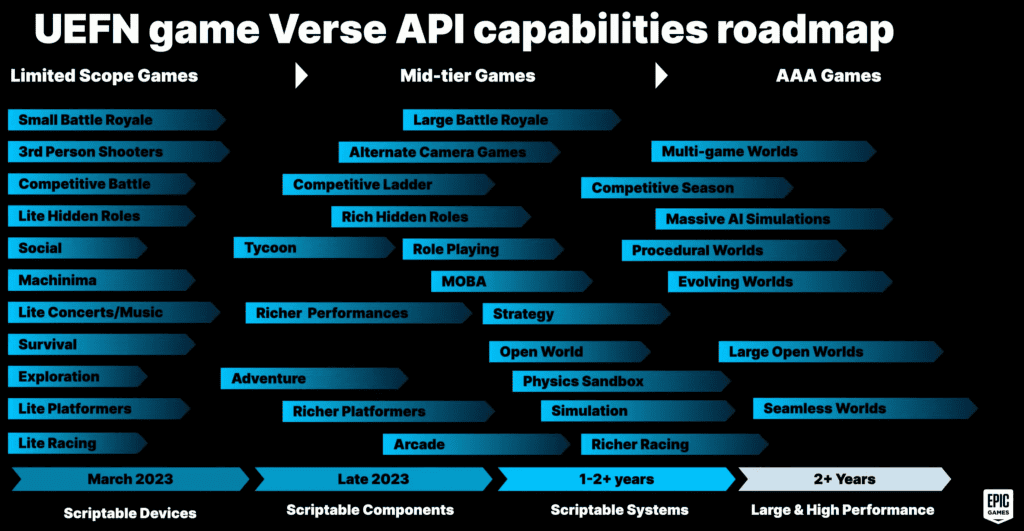
Source: State of Unreal
I look forward to seeing what else Epic Games and its players will bring us in the future! As for me I already jumped in and created some cool experiences. Take a look!